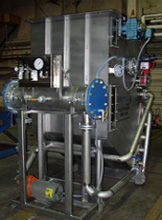
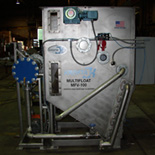
Multifloat Rectangular DAF
The Multifloat is a rectangular DAF unit engineered to fit a wide variety of industrial and municipal applications. The design is modular in configuration. The base Flotation Cell can be built upon, adding additional Flotation Enhancement Cells (FECs) to accommodate a range of flow capacities (vertical or horizontal arrangements are available). The entirely stainless steel rectangular units are offered in 50-3000 gpm capacity standard designs. However, should space be a critical factor, the Multifloat can be customized by changing the surface area of the FECs within the unit. This will allow the dimensions of the unit to vary in the X, Y, and Z-axis to fit any situation.
Multifloat Operation
A mix of raw wastewater and aerated recycle flow are introduced at the base of the Multifloat. A header pipe, affixed to the outside of the unit, distributes the flow to the individual FECs within the flotation tank (the FEC's design allows for even distribution of the flow across the unit). By swapping the influent/effluent piping to either side, the Multifloat can be placed tightly against a wall. Retention time within the unit will vary with the amount of raw water being processed, but is generally a minimum of 3-4 minutes.
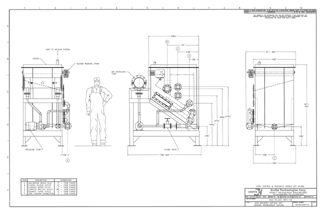
Flocculated particles attach to the aerated water and float to the surface close to the plate inside the FEC. The plates expedite the rise rate by reducing the hydraulic head over the particle. Clarified water is drawn back down to a collection area below the bottom of the FECs. The clarified water then flows up over a divider plate at the top of the tank and into a clearwell reservoir where it is discharged, by gravity, out of the unit. The system features an automatic leveling control system. A portion of the flow is captured and "recycled" back to the Air Dissolving Tube (ADT) through a separate connection. This ensures the flow to the recycle pump will not stop and cause damage should the flow to the unit be shut-off. Floated materials are collected at the top of the FECs and directed towards the sludge collection rake assembly. The rake pushes the floated material over a simple beach design and deposits it into a small sludge collection trough. It is then discharged by gravity. Grit and non-floating debris are collected in the bottom of the unit. Because of the small footprint of the Multifloat, a scraping mechanism is not required. The bottom sediment sump is purged automatically at intermittent intervals. One or more (depending on the size of the unit) butterfly purge valves are operated by a simple timing mechanism in the control panel or PLC. The unit is supported by four legs included with the basic package. The Air Dissolving Tube can be mounted to the unit or placed close by in a convenient location. Depending on the effluent quality requirements, the system may be operated with or without chemical pretreatment for coagulation and flocculation.
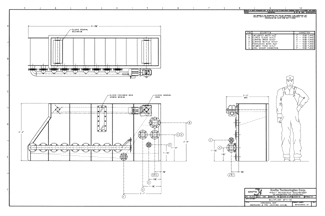
Air Dissolving Tube (ADT)
A portion of the clarified water, typically 20%, is recycled to feed the air dissolving system. A standard centrifugal pump draws clarified water from its source into the ADT, where it has an 8-12 second retention time. A uniquely designed influent nozzle causes the flow from the recycle pump to enter the ADT in a spiraling pattern. Compressed air, injected across the surface of a panel located inside the ADT, is dispersed evenly throughout the tube. The air mixes with the recycle water stream and is dissolved. A "bleed-off" mechanism prevents too much air from being introduced into the recycle stream, as this could cause air binding in the tube (the formation of coarse air/ large air bubbles). The pressurized flow is fed through an inlet header, where it ultimately mixes with the raw water.
A globe valve, located on the discharge line, controls the flow. Flow through the tube can be readily gauged by the difference in pressure from the inlet nozzle to the center of the tube. Krofta provides the valves, gauges, rotometers, site tube, and safety relief valves for this system.
The ADT does not usually qualify as a pressure vessel so it is not subject to ASME coding or annual certification.
Features and Advantages:
- Two Plexiglas flotation viewing windows for flotation/process observation.
- Complete skid mount packages including process piping, control panel packages, compressor, chemical feed equipment, and pumps which are ready for use once installed on a flat concrete pad.
- Suitable for use in explosive environments.
- Vertical (MFV) or horizontal (MFH) configurations are available.
- 304L or 316 stainless steel construction.